
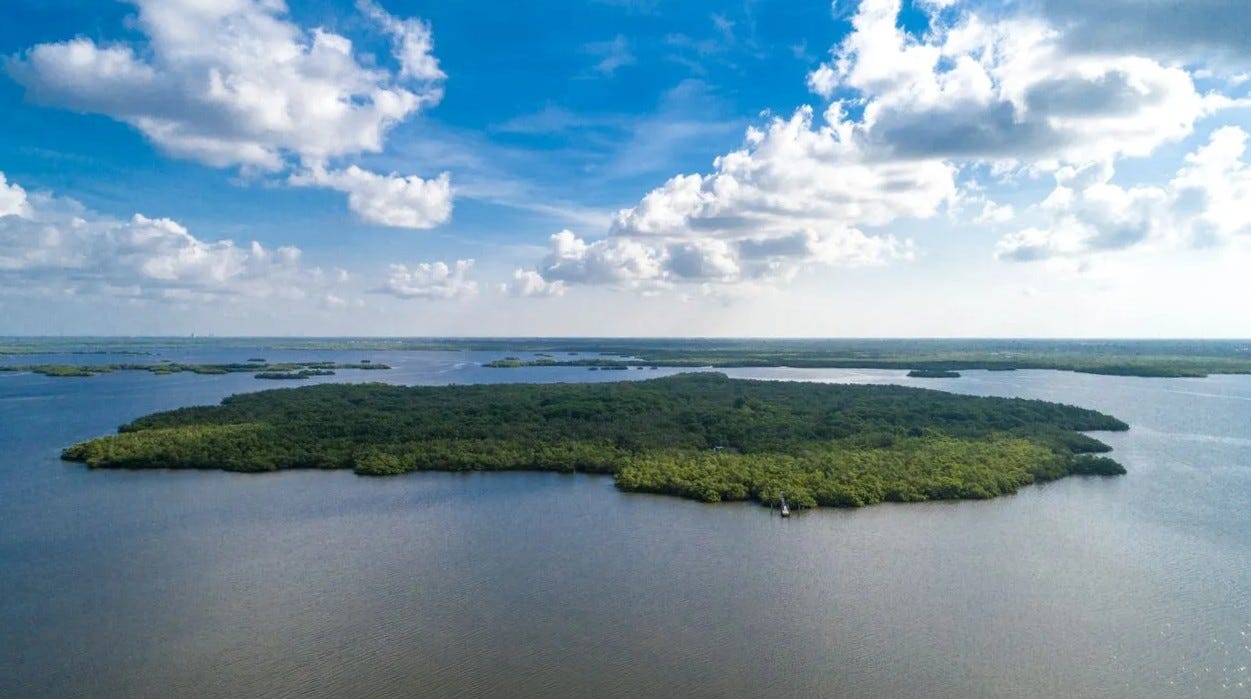
Two Spanish vessels enter the bay. Their intel says some of their own are living as captives in the area. In fact, nearly 200 shipwrecked Spanish men and women have ended up in Calusa hands over the years. While most of the men were killed, some of the women married into the tribe and now have children of their own.
The vessels anchor just offshore. Caalus, king of the Calusa, lord from Cape Canaveral to Key West, responds. He sends one of the captives, fluent in both languages, to give instructions for parley. But the Spanish leader, Pedro Menéndez de Avilés, whose presumptuous title is Adelantado of Florida, is wary. This interpreter speaks Spanish but he dresses like an Indian; it is not clear where his loyalties lie.
Menéndez devises a plan and manages to invite Caalus on board. The two do a diplomatic dance. Menéndez quietly lifts anchor, drifts out into the bay, and threatens to kill him. Menéndez’s men suggest the De Soto method: hold the king captive until the Calusa deliver all the gold and silver and captives they have. Menéndez is no stranger to bloodshed; he is fresh from his massacre of over a hundred French Protestants on the other side of Florida. Their bones are still there on the sand.
But Menéndez is a fervent man, a devotee of the Catholic Church. He wants to establish an alliance with the Calusa for the benefit of future missions. He offers Caalus an alternative: return the captives in exchange for many gifts from the Spanish and be his great friend and brother. King Caalus chooses this option.
The Royal Wedding
The Calusa are men of their word. The next evening they host a state dinner at their temple, an enormous thatched structure on a raised mound where, according to one of Menéndez’s men, 2,000 men might gather therein without being very crowded. Carved painted masks adorn the walls. The evening begins with pomp and circumstance. Calusa men sing songs and girls dance, the usual diplomatic welcome. The Spanish provide trumpeters and a dancing little person. Menéndez charms the hosts with kind words in the native tongue that he has written on paper.
He greets a woman he assumes to be the First Lady. King Caalus leans over from his royal seat on the dais and informs Menéndez, using one of the captive Spaniards as interpreter, that that woman was not his wife, but his sister; the one whom he had given the Adelantado for a wife. This is the traditional way to cement an alliance. It does not matter if Menéndez is already married. Caalus himself has many wives, the sisters of other caciques across the land.
Menéndez in unfazed. In fine diplomatic etiquette, he rose and took her by the hand, and seated her next to him, between him and the cacique, and through what he carried written, he said many things to her in her language, reading from the paper; whereat they rejoiced, and all the Indian men and women who were there.
But Caalus has the upper hand. His sister, given in marriage to the Spaniard, is described as 35 years old, not at all beautiful. Now his principal wife, the real First Lady, arrives and takes her place on the dais. She is wearing a pearl choker, a gold necklace, and a short skirt covering in the front. That is all. She is described as 20 years old, very comely and beautiful, with very good features: she had very fine hands and eyes, and looked from one side to another with much gravity and all modesty: she had a very good figure, for even among the many Indian women who were seen to be handsome, not one was as handsome as that one.
Menéndez needs to counter. He has his men bring in gifts for both women: green gowns, beads, scissors, knives, bells, and the biggest hit of all: mirrors. The hosts are delighted.
The royal entourage, Caalus with his beautiful wife, Menéndez with his new wife, with hundreds in attendance, dine in elegance, feasting on fish and oysters provided by the hosts, and biscuits, wine, and honey from the guests, complete with a table and tablecloths. At this point, Menéndez claims the upper hand, thinking they well understood that our food was better than theirs.
The Honeymoon
The meal over, Menéndez suggests it is time for him to retire for the evening. Caalus leans over and suggests he should go and rest in a room which was there, with his sister, since he had given him to her as his wife. Menéndez is now a bit fazed. Caalus makes his point clearer, that if he did not do this the cacique’s Indians would be scandalized, saying that the Adelantado was laughing at them and at her and held her to be of little account; and there were in the pueblo more than 4,000 Indian men and women. It is a military threat.
Menéndez comes up with a quick excuse, that Christian men could not sleep with women who were not Christians.
No problem, says Caalus, he and his people were Christians already since he had taken him for his elder brother.
At this point, their conversation devolves into a theological debate, the conclusion being that Menéndez will take his new bride back to his own tent for the night. Here the adelantado and his captain discuss the issue in the dark. If he does not sleep with his new bride, a serious fracture in the alliance may erupt. They conclude that they should baptize her and give her a name; and the Adelantado should sleep with her, for this would be a great beginning to their trusting him and the other Christians; that all those Indians and the caciques, their neighbors, would then become Christians. It is all for the sake of the missionary endeavor.
The next morning, King Caalus comes to visit. He is pleased. The Spanish vessels prepare to depart. They have on board nine freed captives and a peace treaty with the Calusa, personified in Caalus’ sister, who has been renamed Antonia. She now heads for Havana, to be taught in the ways of the church. At the last minute, two Spanish women, captives and now wives to Calusa men, escape the vessel. They disappear back into the woods, unwilling to forsake their Calusa children.
Father Rogel’s Catechism Lessons
Eventually, the Calusa permit the establishment of a permanent Spanish embassy in their capitol. As the months go by, the people of Mound Key and the Jesuit priests work out a kind of dance. Proselytizing in town is not allowed, but the priests are permitted to offer classes on religious instruction at the mission compound.
Father Juan Rogel writes a letter home, expressing his frustration with the progress:
A short time after they had begun to come, when I began to undeceive them of their errors and idolatries and evil customs and wicked laws that they have, such as killing their children or permitting sodomies, killing innocent persons, etc., they soon began to abandon coming to the catechism lessons.
They said to me that their forebears had lived under [their] law from the beginning of time and that they also wanted to live under it, that I should let them be, that they did not want to listen to me. However, by treating them with gentleness and with love and bringing them a little bit of maize at times, while we had it, with that bait they were frequenting the catechism lessons. Although the king had already left off coming because of being too busy with and involved in his idolatry, they learned the prayers well while the handouts lasted and they were already beginning to believe the things that I was telling them. But when the handouts ended, they all took off.
Intrigue at the Embassy
The students of Father Rogel’s classes are not the only visitors to the mission. Young Calusa women also visit the Spanish security staff. They become loyal to their boyfriends, serving as their eyes and ears in the community. King Caalus wearies of the embassy – the romantic alliances, Father Rogel’s proselytism, and the meddling in Calusa affairs.
He makes up his mind to annihilate them. The embassy must go.
The priests have also been deliberating. They have also made up their minds: regime change. Caalus must go. They have a ready puppet in Felipe, the head of the Calusa military, and he has a hereditary claim to the throne. When conditions are ripe, the green light is given. Caalus pays a visit to the embassy, but he does not return. The Spanish send a message to Havana and Madrid: they were compelled out of self-defense.
Felipe assumes the Calusa throne. Spanish lives have been protected. Freedom has been restored.
Felipe has the support of the Spanish, but not the people. To quell the inevitable coup attempts, he embarks on a reign of terror with targeted political killings. As the weeks go by, the Spaniards at the embassy are taken aback to see Felipe and his followers dancing around severed heads. Spanish intelligence provides this evaluation: The reign and life of that cacique [Felipe] depends on the Christians not withdrawing their support from him because he is so disliked by so many caciques and captains among his vassals that, were it not for the favor and support that he enjoys among the Christians, they would have killed him quite a while ago. The Spanish embassy becomes the de facto capitol, propping up the puppet.
Last Dance
But Felipe is a wayward puppet, too loose in his strings. One day, the Calusa rise up, kill him, and drive the Spanish out. The nationalist fervor spreads. Up in Tocobaga, in Tampa Bay, the cacique hears the stories and acts quickly. They storm the embassy there and kill all the Spanish. At Tequesta, on Biscayne Bay, they kill four Spaniards. The survivors close their fort and flee.
The Spanish are driven from Florida.
References
Hann, J.H. 1991. Missions to the Calusa. Univ. Press of Florida.
Solís de Merás, G. Translated by D. Arbesu. 2020. Pedro Menéndez de Avilés and the Conquest of Florida: A New Manuscript. Univ. Press of Florida.