900 dead horses
and 436,000 bombed homes

I was on my way back from Idaho – a memorial service – and wanted to visit a historic site: the place along the Spokane River where, in 1858, Colonel George Wright of the US Army captured the fleeing Yakama and ordered his men to round up their 900 horses and kill them.
Supposedly their bones are still along the river. But I couldn’t find the spot. It was just inside the Washington border, between a town called Liberty Lake and the state line. I pulled off the highway where tall ponderosas punctuated the bluff across the river. There was a small park, a bike path, and a sign about the “Centennial Trail,” but no mention of the Yakama or horses. No memorial. Nothing.
I’m used to this at significant sites in Native history. The nothingness, except for those of us who know our stories.
When the army was finished with the horses, each one lay with a gunshot wound behind the ear. An army captain recalled: “It was a cruel sight to see so many noble beasts shot down. They were all sleek, glossy, and fat, and as I love a horse, I fancied I saw in their beautiful faces an appeal for mercy. Towards the last the soldiers appeared to exult in their bloody task; and such is the ferocious character of men.”
The horses were killed as part of a scorched earth policy, to strip the Yakama of all wealth, means of transportation, and means of living, in order to imprison them in a concentration camp. The precipitating incident was the rape of a disabled Yakama girl by a white miner. A Yakama leader, Qualchan, had applied justice in the case, killing the miner. That was unacceptable to the US Army, so they hanged Qualchan and brutally punished the entire tribe.
I’m sure the whole story was more complicated than this because, of course, the settlers wanted the land. Today, the Yakama’s land consists of white ranches and vineyards, the Yakama Indian Reservation, and the Hanford Nuclear Reservation, where the atom bombs were made and the decaying generations of radionuclides can rest undisturbed. It is the largest contaminated site in the nation.
~~~
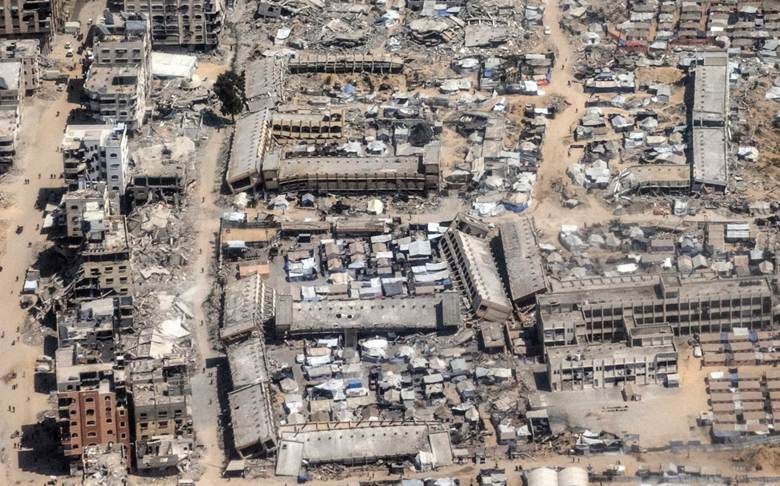
Last week, a photographer from the Washington Post managed a ride-along on a plane out of Jordan that was dropping food aid to the starving Palestinians in Gaza. No photography was allowed. The Israeli military likes to keep secrets, even if those secrets can be seen across the world on social media or even from outer space. But the Jordanians and the Post photographer didn’t get the memo, so he clicked away out the rear cargo bay.
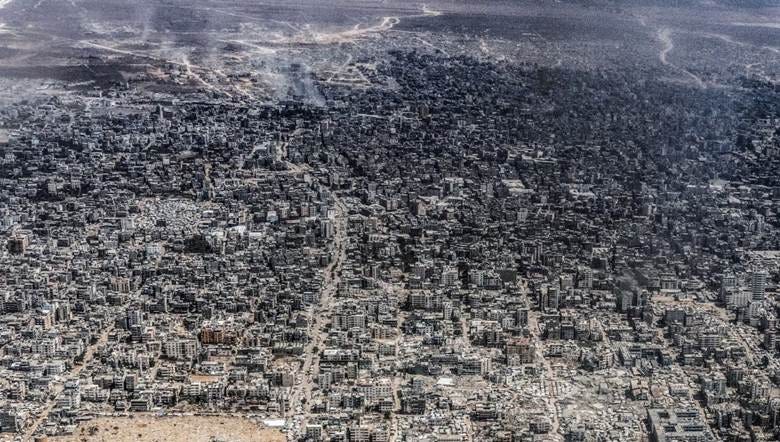
His photos revealed a gray moonscape of a ghost city, buildings empty, teetering, crumbling, reduced to a fraction of their normal half-lives. Smoke or dust or both wafted from the ruins, which seemed even more dystopian than Hanford or that pile of 900 dead horses along the banks of the Spokane River.
They say that 436,000 Palestinian homes have been destroyed, about 92% of the total. This makes me think perhaps some of those appaloosas got away. American weapons are never 100%; there are always survivors.
~~~
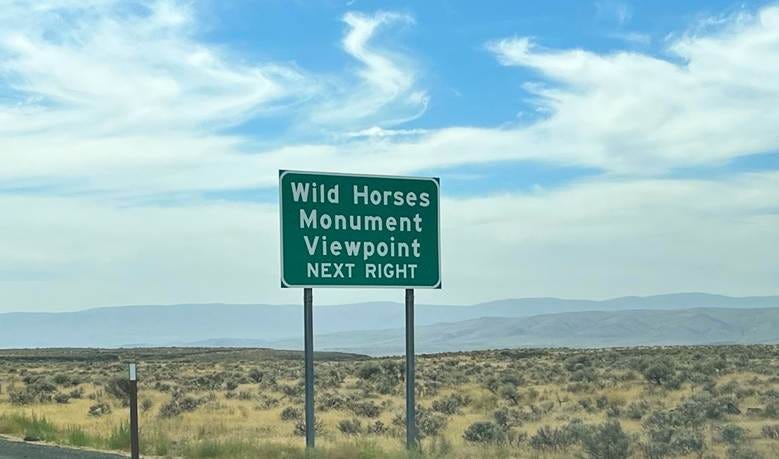
Two hours further west along I-90, I saw a highway sign for a monument more suitable for settler colonial sensibilities: the Wild Horses Monument Viewpoint. This allows visitors to gaze across the sagebrush of the Columbia River Plateau and see 15 wild horses galloping on the horizon. They are free. Except they are iron facades, installed in 1990 to celebrate 100 years of Washington statehood.
The art installment is dramatic, evoking an empty land and a noble people who, sadly, had to fade away to further the cause of civilization – the usual delusions of genocidal colonists.
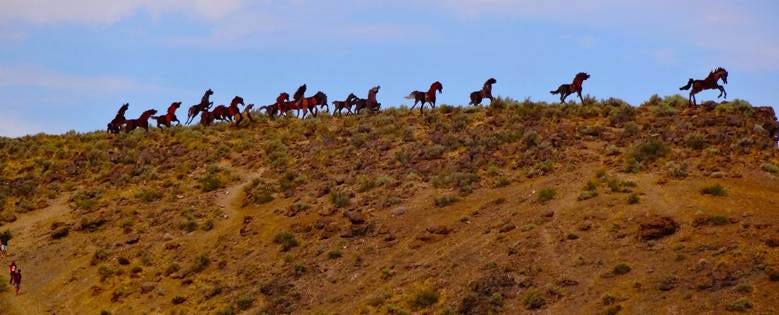
The artist said the statues, which sit on Yakama land, also honor Native Americans. He even concocted his own faux-Native tale to explain the horses as gifts from “Grandfather Spirit.” Just weird shit.
What memorial will the Israelis erect in Gaza?
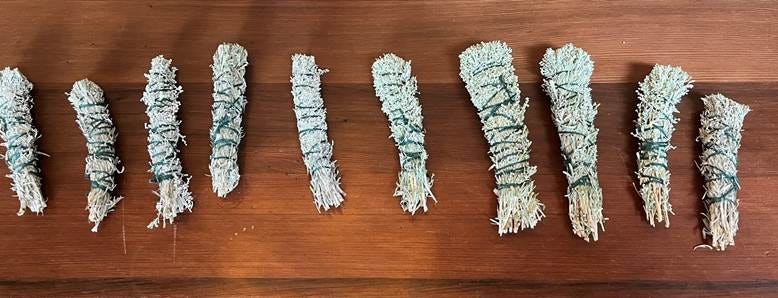
We pulled over, not to see the iron horses, but to collect sage. Despite all the gunshots and bombs, the sage is still there.
Thank you for this. You let the land and history speak for itself. A lot to ponder and let sink in.
Devastating and powerful writing